At the
outbreak
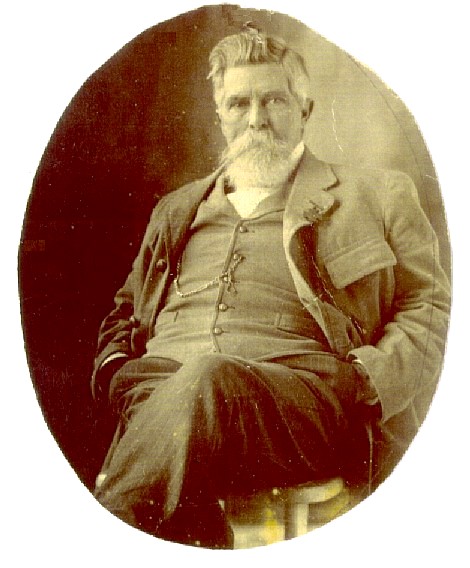
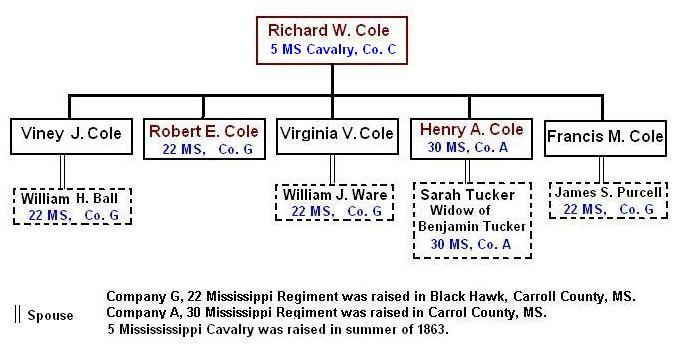
of the War, Henry Asbury Cole was 16 and living with his family in
Black
Hawk, Mississippi. His parents were Richard W. Cole and his wife,
Eliza Jane (Jones).
His older brother, Robert E. Cole, was 19. An older sister, Jane, was
married
to William H. Ball1
. This is the story of this family's participation in the Civil
War.
Benjamin F. Tucker and Jane's husband are included since they enlisted
in the same unit as the members of the Cole family.
The country erupted into civil war in April 1861. Many young men
were moved with emotion to join and fight for their new country, the
Confederate States of America. This fervor caught on at Black
Hawk as several men enlisted to form a regiment that was named after
the town: the "Black Hawk Rifles". Among those who enlisted on
April 20 were Robert E. Cole and his brother-in-law, William H. Ball,
and James S. Purcell2, 19. James S. Purcell
also enlisted and he would someday marry one of Henry’s sisters.
Once formed, the new company reported to the main training base near
Grenada. There other companies from around the state were formed
into regiments. When the Black Hawk Rifles arrived, all the
regiments had been formed. For months, the unit
could not find enough men to assemble together.
Several
members became discouraged. Captain H. J. Reid traveled to Richmond to
obtain an order from the war department to have their companies
mustered
into Confederate service as independent companies. On Sept. 6, 1861, 78
officers and men re-enlisted into a unit that became the "22nd
Mississippi Regiment,
Company G"3.
The regiment was sent directly to the campaign in Kentucky.
The
regiment was bivouacked at Camp Beauregard near Feliciana, Ky., from
Nov. 1st to Dec. 25th. During this period from Nov. 1st to Dec. 25th,
the regiment participated in night marches in the freezing rain. Many soldiers became
sick due to exposure to the elements18. Several of the regiment
were discharged due to illness or died of pneumonia. Even the
regiment's commander, Col. Bonham, became ill and died8. Private Robert Cole
died on Dec. 1, 1861. His father, Richard Cole, traveled to Kentucky to
claim his son's body. He signed discharge papers that described Robert
as a student and included a physical description as: dark hair,
brown eyes. He also received
his
son's back pay of $11/month and $4 clothing allowance. Richard Cole
brought
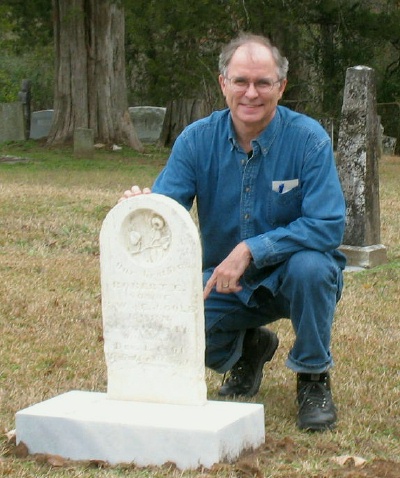
his son back to Carroll County for burial in Black Hawk cemetery. The
inscription
on his tombstone reads:
Robert E. Cole
son of
R.W.
& E.J.
Cole
Sept 18,
1841 -
Dec 1,
1861
|
During
this
time the
young Rebel army was forming, Henry Cole was still too young to enlist.
The family records say that he ran away from home to try to join the
army.
No record of his enlistment can be found until 1863. (There is an
enlistment
record of another H. A. Cole, 37th
Mississippi, Co. A,5
but this person was killed in action.) Henry enlisted in Company A, 30th
Miss.6
, which consisted of men from Carroll County. In this same unit was a
soldier
10 years older than Henry by the name of Benjamin F. Tucker7.
After the war, Henry would marry Benjamin Tucker's widow, which
suggests
the two must have become very acquainted during service. Private
Tucker's
records indicates he was occasionally assigned wagon duty and
transported
injured soldiers to the hospital8.
It is possible that, prior to his enlistment, Henry Cole was assigned
as
a contract mule skinner to assist Private Tucker. The two were most
likely
acquaintances in Carroll County before the war. Another possibility is
that Henry Cole joined a local home guard unit that was disbanded after
the fall of Vicksburg and eventually made his way to Chattanooga.
During
the Vicksburg Campaign, General Grant attempted to enter Vicksburg by
the Yazoo River with a small armada of river boats. They were
stopped at Fort Pemberton located on the conflux of the Tallahatchie
and Yazoo Rivers at present-day Greenwood. Confederate General
Loring organized some units that successfully stopped this
flotilla. One of the units sent to Greenwood was the 22nd
Mississippi Regiment. This battle was very close to Black
Hawk. Surely the family members heard of this threat. It
may have influenced Richard and maybe Henry Cole to take up arms to
defend their country. Vicksburg would fall on July 4, 1863.
After the
recent battles
of Vicksburg and Gettysburg, the Confederates needed more recruits to
contain
the Yankees at Chattanooga, TN. It was at this time, on Nov. 22,
1863, that Henry enlisted
in Company A, "Neill's Guard", 30th
Mississippi Regiment. The 30th
Mississippi was part of Gen. Edward Walthall's brigade, which was
placed
on the western base of Lookout Mountain. The night before the battle,
the three brigades of the Confederate's left flank were placed under a
new commander and repositioned on the mountain. The next day,
Nov.
24, the Yankees had three divisions in position on the west side of
Lookout
Mountain; one division from each of their three armies. Their plan was
to attack across Lookout Creek from the west and advance north along
the slope of Lookout Mountain and crush the Confederate
left flank that encircled Chattanooga.
Before
the
Battle of
Lookout Mountain began on Nov. 24, the 30th
Miss. was under arms an hour before daybreak. Much of the regiment was
placed as a picket line along Lookout Creek and Tennessee River. As the
Yankees crossed below them, the picket line found themselves being cut
off from defenses on Lookout Mountain. Companies I & C were sent
forward
to strengthen the picket line as it gave way before the Yankee assault.
The whole regiment deployed as skirmishers to support it. Men clung to
their posts in the rocks until surrounded and captured. The brigade
finally
rallied after a 3-hour fight just past the Craven's house and held
until
dark9.
Out of his original 1500-man brigade, Gen. Walthall's brigade lost 8
killed,
42 wounded, and 845 missing. Company A of the 30th
Miss. lost 1 officer, 1 NCO and 2 slightly wounded with 14 men missing10.
Private
Henry
Cole
was one of those taken prisoner. He was transferred to Louisville,
Kentucky,
then on to Rock Island Barracks located on the Mississippi River near
Chicago6.
During the winter months, this camp experienced a fever epidemic.
Fifteen
hundred men died from exposure to the cold during the first 6 months of
the camp. The death rate at this time was higher than any time at
Andersonville11.
During
this
time, Private
William Ball, Henry's brother-in-law, was discharged from the 22nd
Mississippi due to medical problems, but would later serve in the
defense
of Atlanta. The patriarch, Richard Cole, was home alone with his wife
and
daughters. Having lost one son to the cause and knowing little about
his
other son and son-in-law, Richard felt compelled to go to the aid of
the
cause. At age 44, he enlisted into Company C, 5th
Mississippi Cavalry, on Aug. 11, 1863. This regiment was formed
under the command of Col. James Z. George. In the fall of 1863, the
5th Mississippi Cavalry saw action in
northern Mississippi
and western Tennessee under Gen. Chalmer's division.
On
November 3, 1863, General Chalmers made his second attempt to attack
the garrison at Collierville, Tennessee. The fort was established
to protect the Memphis & Charleston Railroad but it was also a
valuable target for resupplying their ammunition and horese.
Acting on faulty reports, General Chalmers moved his division quickly
to the town and ordered an attack on what he thought would be one lone
regiment. Instead the Union fort was defended by two cavalry
regiments with artillery. The 2nd Iowa Cavalry regiment was armed
with 5-shot Colt revolver rifles. The 5th Mississippi Cavalry
lead the charge on foot in the attack to take the Union troops crouched
behind the railroad tracks. They were met by a five volleys from
the Iowa cavalry. Colonel George and two officers were the only
men to reach the top of the railroad bed. Colonel George was
captured; the charge was replused.
In January 1864, the 5th
Mississippi Cavalry was assigned to General Nathan B. Forrest for a period
of 6
months13. A
Presbyterian minister from Tennessee, Colonel Wiley
M. Reed 12 was picked to be their new
commander. The 5th Mississippi Cavalry participated in the raid into
West Tennessee. General Forrest established his headquarters at
Bolivar. From there, Forrest's
brigades made raids to Union, Tennesse and to Paducah, Kentucky.
General
Chalmers division was selected for an attack on Fort Pillow that
over-looked the Mississippi River. General Chalmers would be in
command but General Forrest would accompany the division. They
departed Brownsville on 11 April and marched all night in rain and mud
to reach Fort Pillow early on the morning of the 12th. Chalmers’
cavalry quickly drove in the pickets and drove the Union troops into
the inner earthworks of the fort. The Union defense consisted of
519 cavalrymen and artillerymen and 6 cannons. However Chalmers
had the advantage as there were several hills that allowed them to fire
into the fort. Soon the Confederates snipers had killed the Union
commander, which basically left the fort without a combat-experienced
leader. Forrest sent a surrender demand under the flag of
truce. It was refused. Time was critical now as a Union
gunboat anchored north of the fort. The bugler sounded the charge
and the Confederate troopers swarmed over the fort from three
sides. However the fighting didn’t stop as no one gave the order
to surrender.
This
battle was called the "Fort Pillow Massacre", as the Yankees lost over
250 soldiers, mostly black, and 219 captured. The Confederates
lost only 20 killed and 80 wounded. The Union loss was a high
rate
of casualties when compared with the typical battle statistics.
There were
several reasons for the reaction of the Confederates. First they
had gone into West Tennessee to search out Union Colonel Field Hurst
who was taking private property and extorting money from pro-Southern
land owners. Second, the Confederates felt that it was illegal to
take slaves and arm them. The Union forces consisted of the
former slaves serving in the 6th Colored Heavy Artillery and the 2nd
Colored Light Artillery. They also hated the white troops because
they were fellow Tennesseans of the 13th Tennessee Cavalry.
Finally, the Confederates had ridden all day and gotten little rest or
food.
The final
charge against the inner breastworks was lead by McCulloch’s brigade
and included the 5th Mississippi Cavalry. The 5th Mississippi
Cavalry suffered the highest number of casualties which included 5 men
killed and 13 wounded. The remaining killed in this skirmish included:
2nd Missouri had 2; Duffs’ Mississippi 1; Forrest's Regiment 1; and the
4th Brigade, consisting of 2nd, 15th, and 16th Tennessee with 5 killed14. Private Richard W. Cole
was one of these killed in action. Colonel Reed was fatally wounded in
the shoulder, bowels and ankle and died two weeks later. General
Forrest wrote to Gen. Polk on April 15:
"I
sustained
a loss
of 20 killed and 60 wounded.
Among the
wounded
is the gallant Lieut. Col. Wiley
M. Reed
while
leading
the Fifth Mississippi."
After only 6
months serving under General Forrest, the 5th Mississippi Cavalry was
reassigned to a new command.13
As the War moved into the third year, there were more bad news.
The 30th Mississippi Regiment retreated towards Atlanta. Private
Benjamin Tucker was killed in one of the battles around Atlanta,
leaving a widow and two children. Private William Ball appeared on a
roster of local militia defending the city. He was finally
discharged from service due to illness19. The conflict
continued for another year while Henry Cole remained in prison
camp. He was released in March of 1865 from Rock Island prison
and sent to Hospital No. 9 at Richmond6. Apparently, this route
was the only rail line into the South that remained open. He was
discharged from the Army and arrived home three days before Lee's
surrender1.15
A couple
of
years after
the war, Henry married the widow Sarah Land Tucker. They raised the two
Tucker children plus four of their own1. His name appeared
on a list
of veterans in a book for the Confederate Veterans Reunion of 1904 in
Memphis,
TN. He was admitted twice to the hospital at Confederate
Soldiers'
Home at Beauvoir, Miss.; once in 1914 and again in 1920. In 1920 he
applied
for his pension benefits while living with his daughter. On May 22,
1922,
he again entered the Beauvoir hospital and died there on Aug. 27, 192316.
He was
buried
at the
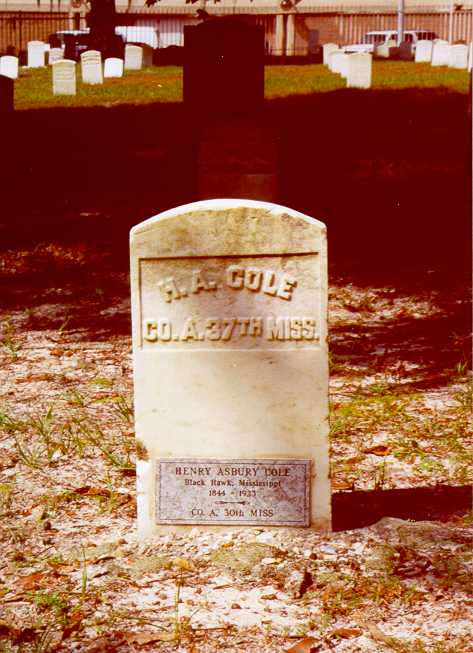
Beauvoir Cemetery on the grounds of the Jefferson Davis Home. His
tombstone,
which bears the incorrect unit, reads:
H. A. Cole
Co. A. 37TH
Miss.17
The final
resting-place
of Richard W. Cole has yet to be located.
James
Slicer Purcell married Richard Cole's daughter, Frances Melissa Cole,
in 1869 and settled in Louisiana. William J. Ware was a sergeant
in the Black Hawk Rifles. After the war he married Richard Cole's
daughter, Virginia "Jennie" Cole, and later moved to Texas.
Henry
Jackson Barrentine's daughter Martha Jane would later marry Richard W.
Cole's youngest son, Richard Bascum Cole, who was too young to
enlist. Richard B. Cole would move to Texas and have 12 children
and many descendants of the Cole family.
|